 |
| Head Wraps for the dry dusty weather |
I recently over heard 3 ladies talking about rocking a style for all of harmattan and getting another for the rest of dry season. Hm! I know its hard to keep our hair soft and moisturized during the harsh dry weather but is it wise to leave a style in for that long? Here are somethings you should consider before keeping that style in....
- Dust in the air: During this season, there is a lot of dust in the air and the oils/butters you have applied hold on to it until you wash. So,what we should aim for is clean healthy hair and not dirty oily 'protected' hair.
Tip: If you can not wash your hair as frequently as you will like, learn to tie head wraps. They are time savers for busy naturals in these dry/dusty times.
- Dry Scalp: Just as your skin gets dry during harmattan so also can your scalp get dry. A sign of dryness can be seen as flakes of dead skin on the scalp or attached to the roots of your hair. Instead of oiling your scalp to hide the flakes wash it off regularly and oil the scalp after wash day.
Tip: To wash your hair/scalp remember to use mild shampoos, bars, clays or apple cider vinegar in place of harsh shampoos that tend to strip off natural oils from your scalp.
Oils like olive oil, coconut oil and jojoba oil are great for oiling the scalp.
- Mama Iyabo: The easiest way to prevent chop-chop (breakage) is by moisturizing your hair frequently. Oiling your hair might make it feel soft but that doesn't mean it is moisturized. By the time you loosen and attempt to detangle, you'll rip the results of your neglect...
Tips: Want to avoid daily styling and breakage while keeping hair clean and moisturized? Simple, plait styles that don't take time loosen e.g Chunky braids and or twists (see my huge braids below). You can carry these styles for 2 weeks or less. What I love most about simple styles is that they allow you...
1. Monitor your edges and
2. Have access to your scalp for proper oiling and washing
Most importantly, chunky braids and twists, if properly done, can be less harmful to your edges (especially when you use extensions)
Noble Dreadlocks was used for both styles above...can you tell that it isn't kanekelon hair?

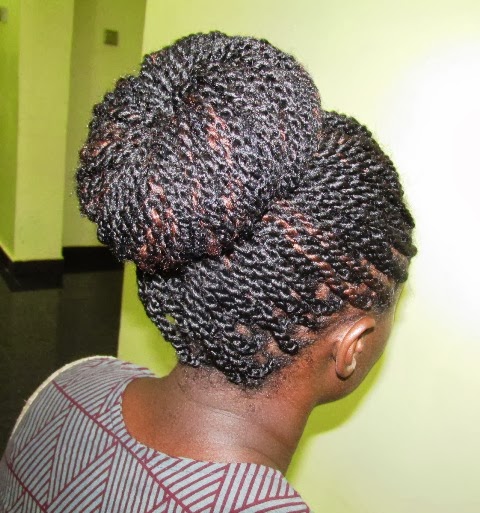
If you prefer Ghana-braids or medium twists as seen in the pictures above go for kinky extensions like Noble Dreadlocks and Royal Silk (see pics. below). Both brands blend beautifully well with type 4 hair so you can wash often without worrying about your hair looking old too soon.


DEEP CONDITIONING
This is one step that can not be overlooked. Dry hair (even when in protective styles) will definitely cause breakage during harmattan. Some of you have sent me mails asking for the best deep conditioners in the Nigerian market and my response, I think, should be very disappointing for the lazy new naturals.
Truth is, my favorite DC treatments come from the kitchen so I hardly ever buy anything in a bottle that is strictly for deepconditioning. See below for some of my favorite harmattan DC treatments:
 1. Coconut Milk : Buy 2 or 3 coconuts, take the meat of the husk and blend it with some water. Separate the chaff from the milk and let it seat in a see through container. I usually do this a day before wash day so I keep the milk in the refrigerator. By the next day, you will notice that the milk has separated from the water. Pour out the water and use the milk as a deep conditioning treatment.
I use this mix when my hair is very dry and before doing a roller set. It always gives me good results afterwards.
 2.Aloe DC Mix: Aloe vera juice helps reduce breakage. For this recipe, I prefer using gel/juice straight from the plant.
- Cut a leaf that grows towards the bottom of the plant.
- Wash leaf and let seat it in a bowl for 10 minutes so the sap can drain from the leaf.
- Using a knife, cut open the leaf and scoop out the gel using a spoon. I sometimes use a knife to scrape out the gel.
- Mix the gel with your favorite conditioner (so it does not drip all over you) and olive oil.
 Lazy Day DC 2: In a little bowl, mix Vo5 moisture milk conditioner (or any other conditioner that is handy) with olive oil or coconut oil, and a few drops of peppermint oil (for the effect). Leave on hair for 30mins or more, rinse and then style. Shikena!
If you have a DC mix or two that you would love to share with us, leave a comment in the box below.
SEALING & MOISTURIZING
This is a very important step in getting soft manageable natural hair during harmattan. Immediately after applying your leave in, follow up with your shea butter mix, or carrier oil.
Tips: Again, please note that oils and butters do not moisturize the hair. Instead of 'pouring' oil on your hair strands when they feel dry, take the time out to...
*Spray on some water,
*Smooth some shea butter or oil on it to seal in the mositure, and
*Thread or braid.
Tip For Your Edges: Spray on some water and then apply your favorite oil to seal in the moisture. This should protect your baby hairs from falling out due to dryness. For me, I apply the oil and then massage it into my scalp as well.
STYLING
 |
| My chunky braids. We used kinky extensions to braid/twist 13 fat rows |
Keeping your ends tucked in is not a bad idea but you can go ahead to be very creative during the harmattan season. There is very little moisture in the air so styles like twist outs and roller sets will last longer than they do during rainy season. Remember that what comes after February is
heat!! So enjoy the few weeks of dry but not very hot weather.
Tips: Before heading out to the salon (whether a natural salon or not) take the time out to properly moisturize and detangle your hair. I have noticed that the longer type 4 hair gets, the curlier it gets at the ends. When braiding, this can be a problem for the stylist as the hair will keep coiling and sometimes begin knotting at the ends.
To avoid this, spray on some water a day before going to the salon, and comb/detangle hair properly to separate clumped hair strands and take out shed hair. Smooth on some of your favorite oil and then braid or thread.
If your hair is properly detangled it should be much more easier for the stylist to separate your hair at the ends without much of a problem- using just his/her fingers.

After washing my hair and leaving it in braids for some days, it clumps together like in the picture above. Sectioning it in this state can be painful so I moisturize, comb, seal, and thread to make it easier for the stylist and I.
(Hi, Lumo Naturals!!)


For me, it is easier to section and braid type4 hair when it is stretched out.

Remember my little sister who did a BC? Yes o, she has gained some length.Yay!!
(more on building regimens for your young ones in secondary school later).
During the holidays, washing and combing everyday was breaking her hair so we decided to do chunky twists. Her hair was clean but very dry so we sprayed water on each section, smoothed on some gel and shea butter, then twisted. She wore this style for a week.


Little sister #3 wanted an updo so I gave her one :). Thanks to gel, a brush and satin scarf, she was able to wear this style for a week. *Sorry, I forgot to take day 7 photos.
That is all for now, feel free to
leave any questions you have in the box below.
Note that most (if not all) of the
points shared above were picked up while
taking care of type 4 hair in Nigeria (different hair types and different weather conditions might give different results to different people). If you have looser or tighter coils,
and any of these tips does not work for you, please go on to
learn more about your hair, be creative this season. Remember to share your
secrets with us though because a lot of Naturals (especially in Nigeria) are still
very confused on what to do with their hair :)
Bless!!


